
During his research, Alex spotted a massive bottleneck holding scientists back. The state-of-the-art tools and techniques that are developed by the academic community carry a brutal learning curve, with new iterations dropping weekly. Scientists excel at inventing methods and gathering data, but turning those results into accessible software is a completely different beast. Crafting clean user interfaces demands a distinct skillset, endless hours, and constant feedback. Sadly, under the crunch of tight grant deadlines, user experience almost always gets pushed to a permanent state of future work.
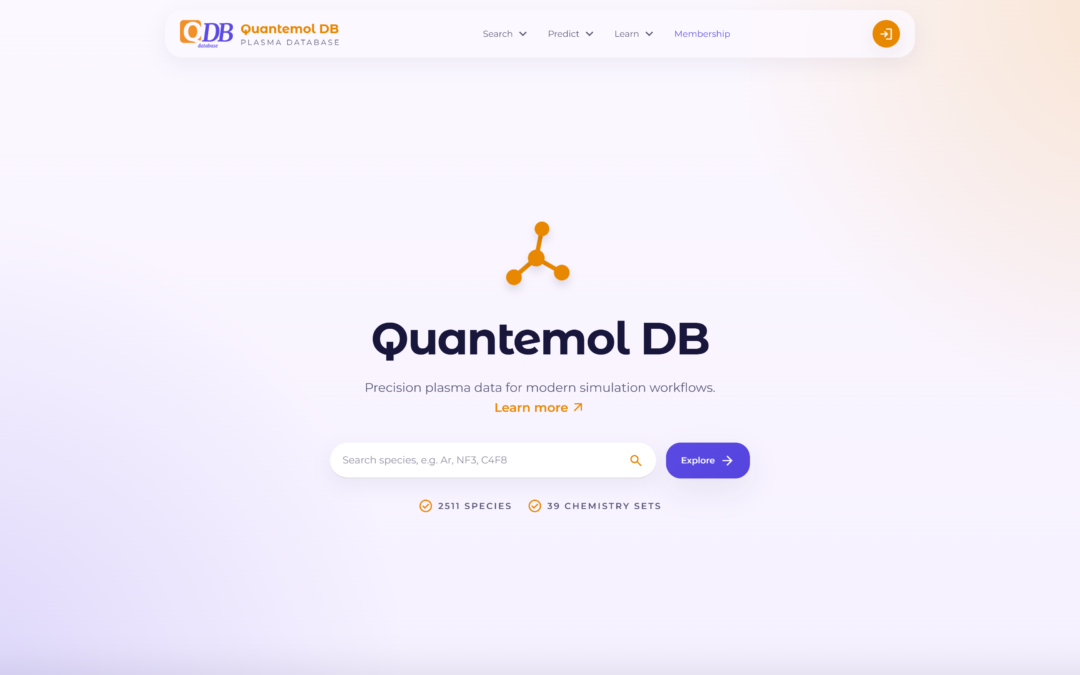
At Quantemol, our goal is to bridge that divide, delivering research insights directly to your screen so you can prototype and make design decisions without the usual headaches. Because understanding plasma processes always starts with the data, we built QDB as the ultimate centralised hub for reaction cross-sections, kinetics, and validated chemistry sets. The core mission of this redesign was simple: make this vital data effortless to find and read.
Managing complex chemical data is notoriously difficult. With thousands of reactions involving various molecules or atoms, some spanning hundreds of unique states, precision filtering is non-negotiable. To solve this, Alex stripped down the chemical species search interface to its core. The new design breaks each species into its basic components, introduces specific filters, and adds smart autocomplete suggestions. The updated reactions search interface lets you input states in a dedicated box, use a precise processes filter, and even stack multiple reactants or products in a single query. This makes wading through a species with thousands of reactions, like O2, incredibly straightforward.
Once you find your data, the upgraded platform makes comparison and downloads painless. Every chemical now has a dedicated species page that highlights ground state properties and NASA polynomial coefficients immediately. Visualising reaction cross-sections and kinetics is equally sharp, featuring an interactive plotting window that lets you look at multiple reactions simultaneously to spot differences instantly. Furthermore, the reaction details pages now show Arrhenius plots, giving you absolute clarity on the spread of rate measurements at your exact processing temperature.
Alex also reworked publication searches on the data sources page and automated the API key integration. Gold and Platinum members can stop emailing request forms because keys now live directly on the account details page, keeping your custom code running without pauses. Validated chemistry sets now offer total openness, laying out the full list of included reactions alongside the exact calculation methods used to check them. Even surface data like sticking coefficients and sputtering yields received a bump for smoother navigation.
In addition to overhauling the frontend user experience, changes have also been made to the binary diffusion coefficient estimator. Prediction speed and model performance has now been improved, making estimation more reliable.
Wrapped in a crisp, modern look that aligns with our new branding, this updated digital hub is coming soon, ready to kickstart your molecular and plasma design projects.
By Annie Laver & Alex Moriarty

Annie Laver
MARKETING & EVENTS MANAGER

Dr Alex Moriarty
PLASMA DATA SCIENTIST