
Meet the Experts:
Professor Erwin Kessels
Erwin Kessels is a professor at Eindhoven University of Technology and has been active in (plasma-enhanced) ALD since 2002. His research has since expanded to ALE and area-selective ALD. He has received several awards, including the 2019 ALD Innovation Award, and has published over 400 papers. He is an associate editor of JVST A/B and he is a visiting professor at the National University of Singapore. He is also the driving force behind the AtomicLimits.com blog and founder of the ALD Academy.
Professor Martin Kuball
Martin Kuball is Professor and Royal Academy of Engineering Chair in Emerging Technologies at the University of Bristol, Fellow of IEEE, MRS, SPIE, IET and IoP, he is leading the REWIRE Innovation and Knowledge Centre (IKC) innovating and commercializing next generation compound semiconductor power electronics, an £11M investment by UKRI, and the Centre for Device Thermography and Reliability (CDTR), on power and RF electronics. He obtained his PhD from the Max-Planck Institute for Solid State Physics, Stuttgart, Germany and joined the University of Bristol after being Feodor Lynen Fellow at Brown University, USA.
Professor Julian Schulze
Julian Schulze obtained his PhD in physics from Bochum University in 2009. He is a Professor at the Chair of Applied Electrodynamics and Plasma Technology (AEPT), Faculty of Electrical Engineering and Information Technology, Ruhr-University Bochum, Germany, and an editorial board member of Plasma Sources Science and Technology. His research is focused on high frequency technological plasmas, charged particle power absorption dynamics, Voltage Waveform Tailoring, plasma-surface interactions, and knowledge based plasma process development.
For decades, progress in semiconductor manufacturing followed a general rule of thumb: make everything smaller. That approach is now reaching its limits. As devices grow more complex and features approach atomic scales, controlling the plasma processes used to fabricate them is becoming increasingly difficult.
To understand what comes next, we spoke to three world-leading experts working across the semiconductor ecosystem. Professor Julian Schulze studies the plasma physics behind these processes. Professor Martin Kuball focuses on how plasma interactions affect compound semiconductor materials and their performance. Professor Erwin Kessels works at the interface between plasma science and industrial process technology. Together, their perspectives highlight why controlling ion energy is becoming a central challenge in next-generation fabrication.
Modern semiconductor processes increasingly build and remove material one atomic layer at a time. As Kessels explains:
“We make materials now atomic layer by atomic layer… so it makes sense to do the ion energy control much more precisely. With TWB [tailored waveform biasing], you would have ions with only one energy with not a lot of spread”.
At these scales, even small defects can affect device performance. Kuball stresses how important surface damage has become:
“Anything that can minimise damage on the surface will have a device benefit… if you start with having no damage at all, that is a better starting point… controlling this surface damage is critically important for most compound semiconductors.”
He also points out that the exact location of damage matters less than the fact that it exists:
“Whether it is on the surface or in the top 5 to 10 nm, this is equally bad”.
The challenge becomes greater as devices move beyond planar structures. Three-dimensional architectures and compound semiconductor technologies introduce new electrical and materials constraints. Kuball explains: “When people play around with more complex structures, take 3D vertical GaN technologies such as FINFETs where you have side walls, you must control what you are etching to optimise device performance, including their dynamic performance.”
At the same time, industrial manufacturing demands high throughput. Precise ion control may also improve process speed. As Kessels notes on ALE:
“If you give the ions all the same energy, the exact energy that you need, you can probably cycle faster”.
Achieving both precision and productivity is difficult with conventional plasma biasing methods. As Kessels puts it:
“The energies of the ions are very important, but what we have been doing so far, in terms of ion energy control, is kind of simple… there are a lot of side effects that we learn to cope with, but if we went back to the drawing table we would not do it like this”.
“If you try to continue empirically via trial and error, then the parameter space becomes so large that it would cost a fortune to scan through it”
Why precise ion energy control matters?
Interest in approaches such as Tailored Waveform Biasing (TWB) is growing because traditional process tuning is reaching its limits.
Plasma processes have historically been developed through empirical optimisation – recipes adjusted until the desired outcome was achieved. Schulze explains that this method becomes increasingly impractical as devices shrink and structures become more complex. “If you try to continue empirically via trial and error, then the parameter space becomes so large that it would cost a fortune to scan through it. [A] fortune of money and a lot of time, and that is too much.”
At the same time, new fabrication techniques such as Atomic Layer Etching (ALE) require far tighter ion energy control. TWB is particularly relevant for processing dielectrics; while a monoenergetic IEDF can be generated on conducting wafers by simply applying a DC bias, this method fails on dielectrics due to surface charging. As Schulze explains:
“In a highly selective process such as ALE you usually have an ion energy window which can be as narrow as 10-20 eV and you need to squeeze all the ions into that narrow window to really have energy efficiency and selectivity. And for that, you need monoenergetic IEDFs [ion energy distribution functions]. I think tailored waveform biasing is the only technology that can give this to you.”
“The only solution is to have a better understanding, which you can do with modelling, and to do things as precisely as you can in the lab.”
How precise ion energy control is achieved?
Although tailored waveform biasing may appear new, its origins lie in earlier academic work. Schulze notes that researchers such as Amy Wendt explored these ideas years ago, developing what are now known as “peaks or valleys” waveforms.1
These studies showed that keeping the sheath voltage near-constant during much of the waveform cycle could produce ions with a much narrower energy distribution. At the time, however, the hardware needed to generate such waveforms for high volume manufacturing applications did not exist. As Schulze notes, the “generators were not available” to make the approach commercially viable.
TWB addresses a long-standing compromise in plasma processing. Engineers want ions to reach the wafer with the right amount of energy – not too little and not too much. Conventional approaches struggle to achieve this balance. A direct current bias can produce ions with a narrow energy peak, but it leads to surface charging that eventually shields the wafer from the plasma. Standard sinusoidal RF biasing avoids this charging, but produces ions with a wide spread of energies.
Tailored waveform biasing combines elements of both approaches. The waveform briefly swings positive to neutralise charge that builds up on the wafer surface. It then applies a longer negative phase that accelerates ions towards the wafer. Because the voltage changes very slowly during this part of the cycle, the sheath voltage remains almost constant as the ions arrive.
As a result, many more ions reach the wafer with nearly the same energy rather than a broad range of energies.
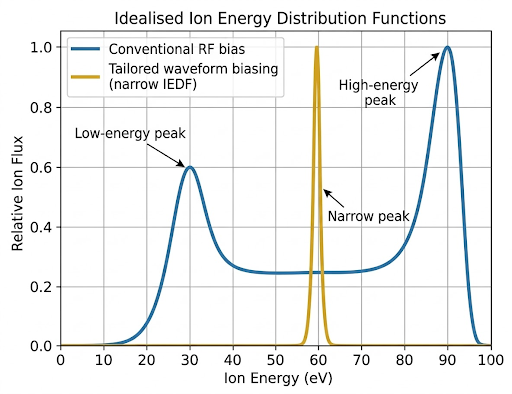
This narrowing of the ion energy distribution is the key reason TWB is attracting interest for highly selective plasma processes.
What physical modelling enables?
As plasma processes grow more complex, physical modelling is becoming an essential tool.
Traditionally, process development focused on experimental recipes. Understanding the underlying plasma behaviour often came later. But as devices approach physical limits, this empirical approach alone becomes increasingly inefficient.
Physical modelling allows researchers to explore plasma processes more systematically. Realistic simulations can combine reactor geometry, plasma chemistry, and electrical circuits within a single framework. For TWB in particular, these elements must be solved together. As Schulze explains:
“An external circuit model has to be coupled self-consistently to the plasma simulation and that has to be coupled self-consistently to a feature profile simulation if you want to look at etching”.
This plasma model must then connect to feature-scale simulations that describe how etching evolves at the wafer surface.
For engineers, these models provide insight that would otherwise require many experimental iterations.
“Simulation and experiments have to go hand in hand, together with modelling”
Looking ahead
If TWB can be implemented reliably in manufacturing tools, it could reshape how plasma reactors are designed. Instead of relying only on sinusoidal RF biasing, future systems may use waveform control to tailor ion energies for specific processes.
Kessels believes this approach could eventually replace conventional biasing in many cases:
“I think that it will replace RF biasing in many cases, especially when precision is required”.
Schulze also imagines reactor architectures built around this level of control:
“Multiple surfaces all strategically positioned and shaped and individually biased by tailored waveforms,” enabling what he describes as “ultimate process control”.
For the semiconductor industry, the challenge now is turning this concept into reliable manufacturing processes. Doing so will require a deeper understanding of how plasma physics, surface interactions and reactor design interact in practice.
That is why combining modelling with experimentation is becoming increasingly important. Efforts are already underway. For example, Quantemol and Oxford Instruments Plasma Technology are collaborating on an Innovate UK supported project “Precision Plasma: Enabling Advanced Semiconductors with Validated Tailored Waveform Biasing” (Project No. 10164196). This initiative explores how tailored waveform biasing could be applied in practical plasma processing tools to advance semiconductor manufacturing.
“Anything that can help the decision processes… you need tools to accelerate this”
The era of empirical trial-and-error processing is rapidly coming to an end. As complex 3D structures demand unprecedented precision, adopting technologies like TWB will be the defining factor in achieving true process control.
Relevant literature:
1. S.-B. Wang and A. E. Wendt, J. Appl. Phys. 88, 643 (2000). https://doi.org/10.1063/1.373715
2. T. Faraz et al., J. Appl. Phys. 128, 213301 (2020). https://doi.org/10.1063/5.002803
3. J. Giesekus et al., Plasma Sources Sci. Technol. 34 115015 (2025). https://doi.org/10.1088/1361-6595/ae215
4. B. Berger et al., J. Appl. Phys. 118, 223302 (2015) https://doi.org/10.1063/1.4937403
5. Q. Yu et al., Plasma Sources Sci. Technol. 31 035012 (2022) https://doi.org/10.1088/1361-6595/ac4c27
6. A. Agarwal and M.J. Kushner, J. Vac. Sci. Technol. A 23, 1440–1449 (2005) https://doi.org/10.1116/1.2013318
7. F. Kruger et al., Phys. Plasmas 31, 033508 (2024) https://doi.org/10.1063/5.0189397
Meet the Authors:
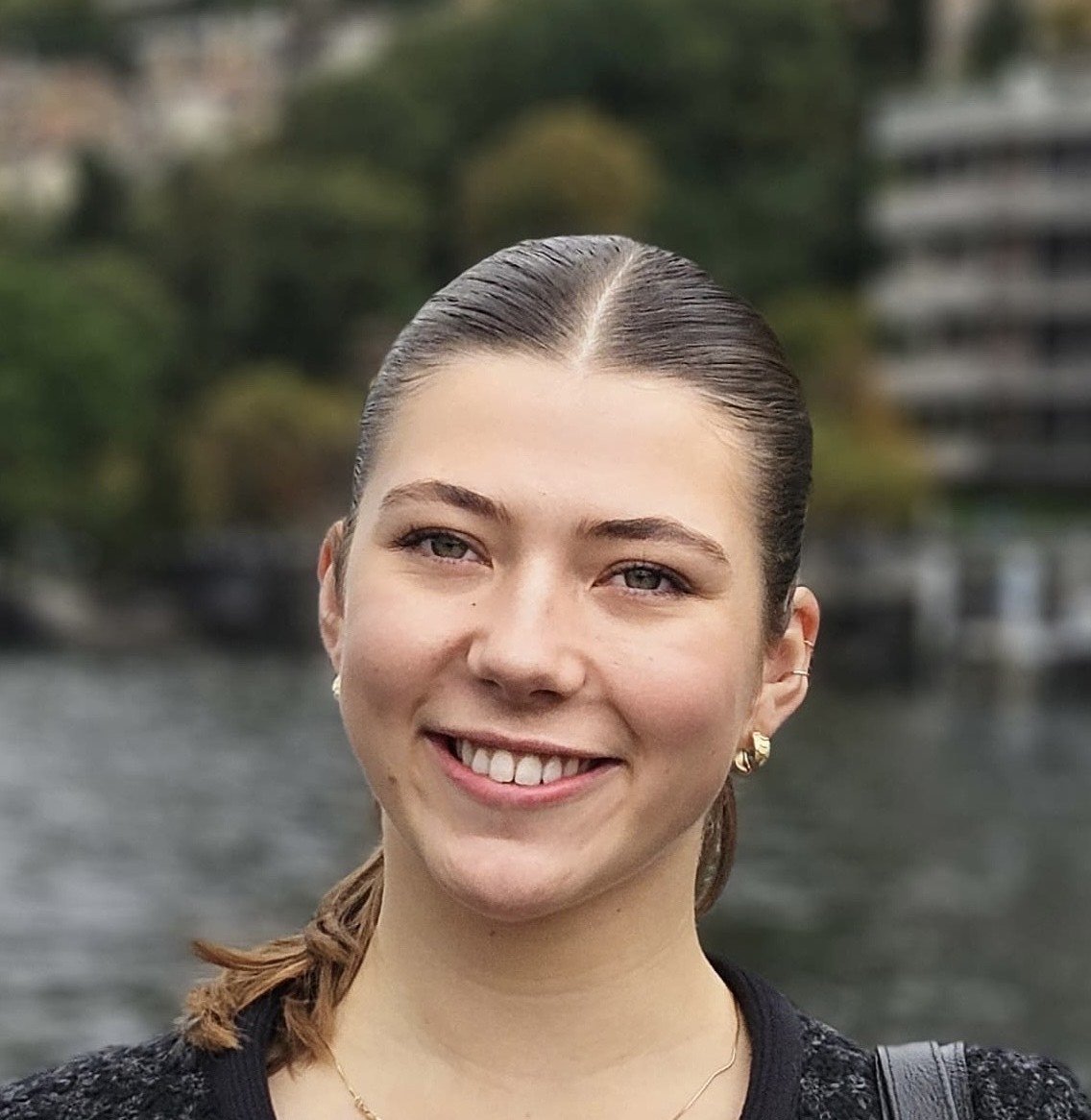
Annie Laver
Annie Laver is the Scientific Communications Administrator at Quantemol, where she is responsible for marketing, project coordination and customer communications. Drawing on her BSc in Chemistry from the University of Otago, New Zealand, she focuses on making complex scientific ideas clear and accessible to a variety of audiences.
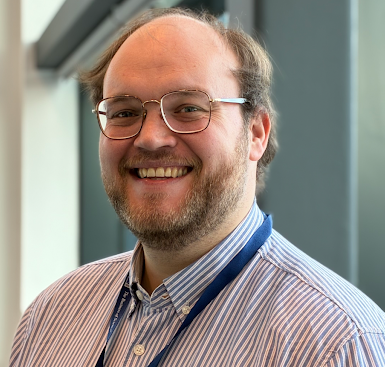
Dr James Ellis
James Ellis is the Innovation Manager for Core Technology and Collaborations at Oxford Instruments Plasma Technology. He has been active in low temperature plasma research for over a decade with a split focus between plasma modelling and experimentation. He runs the Innovation Ecosystem at Oxford Instruments Plasma Technology that sponsors eight PhD students and two postdoctoral researchers.