
The semiconductor industry is currently undergoing a significant shift. As we move into the sub-3nm process node (where features are measured by counting individual atoms), the manufacturing methods of the last decade are reaching their physical limits. At this scale, classical physics gives way to quantum effects, and traditional plasma etching becomes increasingly unpredictable.
To navigate this complexity, leading fabs are moving away from empirical trial-and-error and towards high-fidelity simulation. Quantemol Virtual Tool (QVT), built on the Hybrid Plasma Equipment Model (HPEM) developed by Professor Mark Kushner and his team, is a leading industry tool for modelling these advanced 3D logic structures.
From FinFET to Gate-All-Around (GAA)
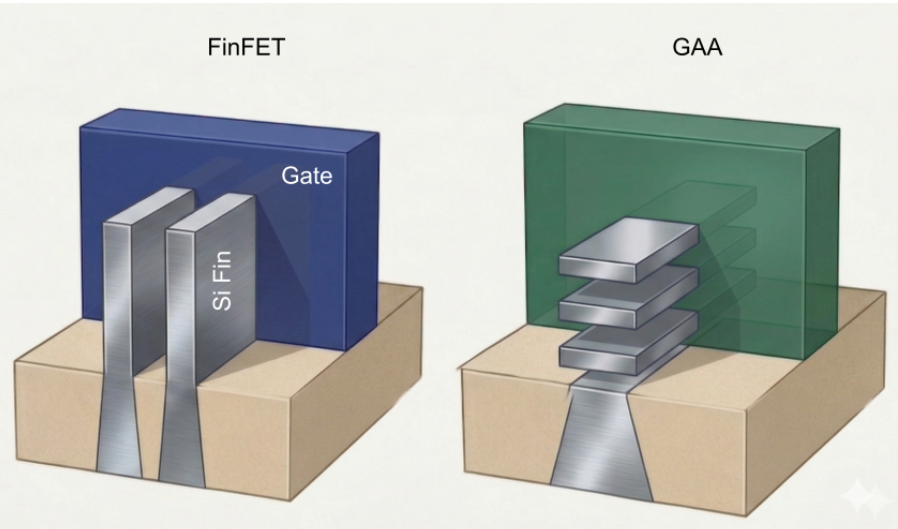
For the past decade, the FinFET (Fin Field-Effect Transistor) was the industry standard. By standing the silicon channel on its side like a “fin” and draping the gate over three sides, engineers were able to maintain electrostatic control and reduce leakage. However, at the 3nm node and below, even the FinFET architecture struggles. The fins become so thin and tall that the gate can no longer effectively suppress “short-channel effects,” leading to power leakage and heat.
The solution is Gate-All-Around (GAA) technology, the architecture powering the most advanced chips slated for 2025 and 2026. In a GAA structure, the channel is sliced into horizontal nanosheets stacked vertically. The gate material is then wrapped entirely around every sheet (top, bottom, and sides) providing the maximum possible “grip” on electron flow.
The Manufacturing Hurdle: High Aspect Ratio Etching
Manufacturing these stacked nanosheets requires extreme precision in High Aspect Ratio (HAR) etching. To create the vertical pillars and channels of a GAA transistor, plasma must etch deep, narrow trenches through alternating layers of materials like Silicon (Si) and Silicon-Germanium (SiGe) without distorting the profile.
Research recently published by Kruger et al (2024) highlights the necessity of Voltage Waveform Tailoring (VWT) in these processes. The study demonstrates that by precisely controlling the energy distribution of ions hitting the wafer, engineers can prevent “bowing” or “etch stop” in deep 3D features. QVT is able to simulate these tailored waveforms, allowing engineers to predict ion transport within the feature before a single wafer is processed.
Atomic Layer Precision and Cryogenic Etching
At the sub-3nm level, the industry is increasingly adopting Atomic Layer Etching (ALE). Unlike continuous etching, ALE removes material one atomic layer at a time using sequential, self-limiting reactions. This provides the near-perfect selectivity required to remove sacrificial SiGe layers without damaging the Si nanosheets.
Furthermore, as discussed in Litch et al (2025), the industry is exploring cryogenic plasma etching to achieve the extreme verticality required for 3D structures. Operating at ultra-low temperatures helps stabilise the chemical reactions at the etch front, a process that is highly sensitive to the plasma chemistry parameters provided by QVT’s database.
Why Simulation is Essential for Sub-3nm
In a modern fabrication plant (fab), a single batch of wafers can be worth millions of pounds. Because plasma is notoriously sensitive to small changes in gas pressure, power, or frequency, “testing” on live wafers is prohibitively expensive.
QVT provides the multiphysics framework to:
- Optimise ALE Cycles: Determine the ideal gas pulse and purge timings to ensure atomic-level smoothness.
- Reduce Yield Loss: Identify potential instabilities in the plasma chamber that could lead to non-uniformity across the wafer.
As the industry pushes beyond the 3nm barrier, the ability to virtually model the “unseen” physics of the plasma chamber is the only way to ensure the success of next-generation logic. If you would like to explore how to utilise QVT’s capabilities in your processes, reach out to us at Info@quantemol.com.
References:
- Kruger et al. Phys. Plasmas 31, 033508 (2024); doi: 10.1063/5.0189397
- Litch et al. J. Vac. Sci. Technol. A 43, 033001 (2025); doi: 10.1116/6.0004250
By Annie Laver

Annie Laver
SCIENTIFIC COMMUNICATIONS ADMINISTRATOR