
In the world of plasma modeling and complex gas chemistry, understanding how electrons interact with molecules is the foundational key. Quantemol-EC (QEC) is excellent for studying how electron collisions excite molecules. But what happens when that energized molecule needs to cool down or de-excite? QEC 2.0 introduces a vital new feature to address this: the ability to calculate vibrational and electronic de-excitation cross sections.
The Missing Piece: De-Excitation
Imagine a molecule is a tiny spring. When a speeding electron hits it, that spring absorbs energy and starts vibrating wildly- that’s excitation. Our previous QEC versions calculated the probability of this initial jolt.
However, in real-world environments like industrial plasmas, highly energetic molecules don’t stay that way forever. They naturally relax, shed their extra energy, and return to their stable, lower-energy state- this is de-excitation.
The New Methodology in QEC 2.0
This is a brand new feature in QEC 2.0. For the first time, our electron collision software can calculate the cross sections for this essential inverse process.
The new methodology provides comprehensive data for two critical types of relaxation:
- Vibrational De-excitation: The molecule stops its excessive shaking (its internal bond vibrations quiet down).
- Electronic De-excitation: The molecule’s electrons settle back into their lowest energy orbits, releasing the energy they gained.
Why De-Excitation Matters for Plasma Modeling
By including de-excitation, QEC 2.0 transforms from a model of how molecules gain energy to a complete, two-way model of energy exchange.
A plasma is a chaotic dance of particles constantly colliding and exchanging energy. To accurately simulate the chemistry and physics of a plasma (whether for semiconductor etching, lighting, or fusion research), you need to know not just how molecules get excited, but also how they relax and give that energy back.
- More Comprehensive Picture: QEC 2.0 now provides a complete view of the electron-molecule collision process, accounting for processes that start from states other than the simple ground state.
- Enhanced Plasma Modelling: The inclusion of these de-excitation cross sections means the data you feed into your subsequent plasma modeling simulations is more realistic and reliable, leading to more accurate predictions of plasma behavior.
The figures below showcase this capability in action, illustrating the calculated probability (cross section) for both the initial vibrational excitation (energy gain) and the new de-excitation process (energy loss) in H2S collisions.
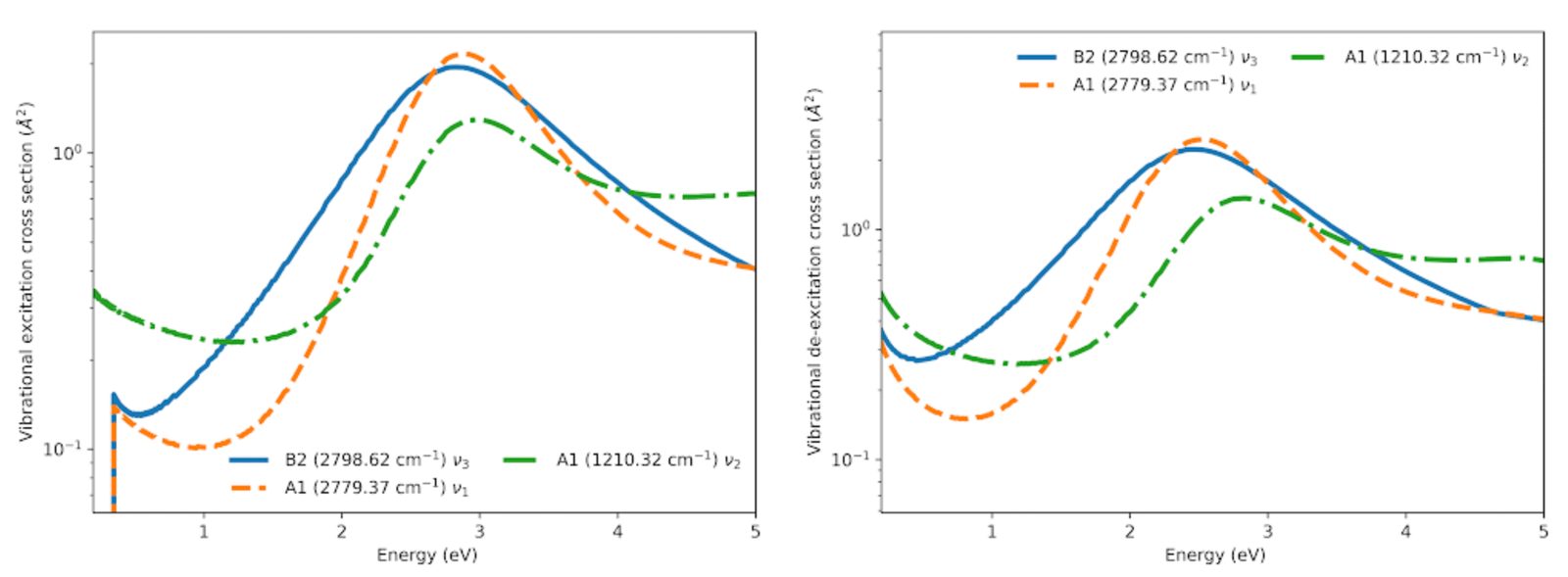
QEC 2.0 represents a significant leap forward, ensuring that your simulations are based on the most comprehensive data available. To explore the latest QEC release and its capabilities in more detail, visit the Qauntemol website and Contact us to request a free trial.
By Greg Armstrong and Annie Laver
Dr Greg Armstrong
PRINCIPAL COMPUTATIONAL MOLECULAR PHYSICIST

Annie Laver
SCIENTIFIC COMMUNICATIONS ADMINISTRATOR